The Real Cost of Solar in 2026: What Homeowners Actually Pay
In 2026, most homeowners pay $15,000–$40,000 for a solar system before the 30% federal tax credit. After applying the credit, your actual cost is typically $10,500–$28,000. A typical system size is 5kW–10kW (about 12-25 panels), depending on your electricity usage. Costs vary by location, system size, and roof characteristics — estimate your solar cost instantly using our calculator.
Calculate Your Solar Cost Now →
If you've been putting off researching solar because you assume it's too expensive, the 2026 numbers might genuinely surprise you. The average American homeowner now pays $14,000–$17,500 for a complete solar system after the 30% federal tax credit — and that figure pays for itself in saved electricity in 7–9 years. For homeowners in high-electricity-rate states like California, Hawaii, Massachusetts, or Connecticut, payback happens in as little as 5–6 years. Learn how the federal solar tax credit works and what it means for your savings.
But "average" covers an enormous range. A small 5 kW system in rural Arkansas might cost $11,000 after incentives. A 15 kW system with battery backup in San Francisco could run $35,000+. Understanding what drives that range — and where your home falls — is the entire point of this guide.
2026 Solar System Cost by Size
System size is the single biggest cost driver. Installers price solar by the watt, with the national average running $2.50–$3.00 per watt installed in 2026. Here's what that means at common system sizes:
| System Size | Avg Gross Cost | After 30% ITC | Est. Annual Output | Homes Covered |
|---|---|---|---|---|
| 4 kW | $11,200 | $7,840 | 5,600 kWh | Small apartment/condo |
| 6 kW | $16,800 | $11,760 | 8,400 kWh | 1,200–1,800 sq ft home |
| 8 kW | $22,400 | $15,680 | 11,200 kWh | 1,800–2,500 sq ft home (typical 3BR) |
| 10 kW | $28,000 | $19,600 | 14,000 kWh | 2,500–3,500 sq ft home |
| 12 kW | $33,600 | $23,520 | 16,800 kWh | Large home or EV charger |
| 15 kW | $42,000 | $29,400 | 21,000 kWh | Very large home or pool |
Note: These figures assume average US installer pricing. Costs vary by 15–25% depending on your state, installer, roof type, and panel brand. For a detailed breakdown of solar panel cost for a 3 bedroom house USA, including real-world examples and state-specific pricing, check our dedicated guide for typical residential homes.
What's Included in the Installation Quote
A legitimate solar quote isn't just panels. When you receive a proposal, here's what every line item should cover — and what it typically costs:
| Component | Cost Range | Notes |
|---|---|---|
| Solar panels (equipment) | $0.30–$0.70/W | Varies widely by brand and efficiency rating — see our 2026 panel comparison guide for details. |
| Inverter(s) | $1,000–$4,000 | String inverter cheapest; microinverters cost more but last longer |
| Racking and mounting | $500–$2,000 | Higher for tile roofs, complex layouts, or ground mounts |
| Electrical wiring and conduit | $800–$2,500 | More complex on older homes needing updated wiring |
| Electrical panel upgrade | $0–$3,000 | Required if existing panel is under 150A |
| Permits and inspections | $300–$1,500 | Varies dramatically by municipality |
| Installation labor | $2,000–$6,000 | Higher in high cost-of-living states |
| Utility interconnection fee | $100–$500 | One-time fee to connect to the grid |
| System monitoring | $0–$150/yr | Many installers include first year free |
Solar Cost for Typical Residential Homes
To put these numbers in perspective, here's how system sizes translate to real homes:
- A small 1,200–1,800 sq ft home (2 bedrooms, 1-2 adults) typically needs a 5–6 kW system and pays $13,000–$17,000 after the tax credit.
- A medium 1,800–2,500 sq ft home (3 bedrooms, family of 3-4) typically needs a 7–8 kW system and pays $15,000–$19,000 after the tax credit.
- A larger 2,500–3,500 sq ft home (4+ bedrooms, family of 5+) typically needs a 10–12 kW system and pays $19,000–$25,000 after the tax credit.
For more details on typical home pricing, see our comprehensive guide on residential solar cost for 3 bedroom homes with real examples.
Solar Cost by Home Type and Location
Your actual solar cost depends on your specific home and location. Here are detailed guides for common scenarios:
A typical 3 bedroom home (1,800-2,500 sq ft) needs a 7-10 kW system. Costs range from $15,000-$28,000 after the tax credit. See detailed breakdown →
California has higher installation costs ($2.60-$3.20/W) but higher electricity rates mean faster payback (5-6 years). Check California pricing →
Estimate your solar cost instantly →
Solar Panel Cost by State (2026)
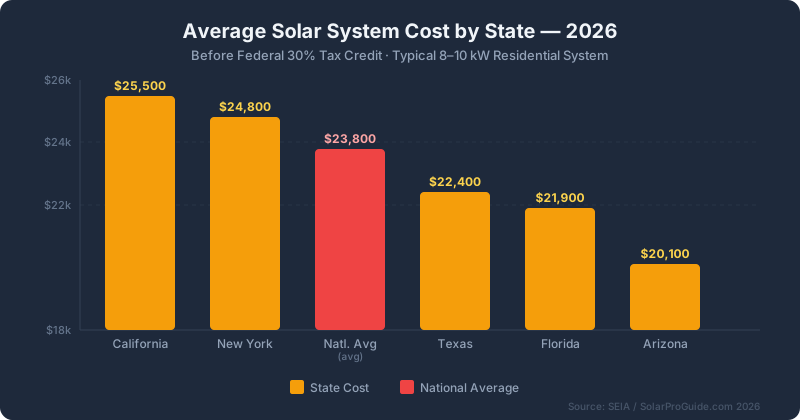
Where you live dramatically affects what you'll pay for solar — and how quickly it pays back. High-labor states cost more to install but often have higher electricity rates, which accelerates payback. Here's the 2026 breakdown for the 15 largest solar markets:
| State | Avg System Cost | After ITC | Avg Rate ($/kWh) | Payback (yrs) |
|---|---|---|---|---|
| California | $27,000 | $18,900 | $0.218 | 5.2 |
| Hawaii | $29,000 | $20,300 | $0.371 | 4.3 |
| Massachusetts | $30,000 | $21,000 | $0.239 | 7.2 |
| New York | $29,000 | $20,300 | $0.230 | 7.4 |
| New Jersey | $27,000 | $18,900 | $0.170 | 7.1 |
| Arizona | $22,000 | $15,400 | $0.128 | 6.9 |
| Texas | $22,500 | $15,750 | $0.129 | 6.7 |
| Florida | $22,000 | $15,400 | $0.130 | 7.3 |
| Colorado | $23,500 | $16,450 | $0.125 | 7.1 |
| Nevada | $21,000 | $14,700 | $0.121 | 6.5 |
| North Carolina | $23,000 | $16,100 | $0.122 | 7.6 |
| Georgia | $23,000 | $16,100 | $0.119 | 7.8 |
| Illinois | $25,000 | $17,500 | $0.130 | 8.1 |
| Ohio | $24,000 | $16,800 | $0.140 | 8.0 |
| Washington | $25,000 | $17,500 | $0.110 | 9.4 |
The 30% Federal Tax Credit: How It Actually Works
The Investment Tax Credit (ITC) is the single most powerful solar incentive in the US — and it's frequently misunderstood. Here's exactly how it works:
The ITC gives you a dollar-for-dollar reduction in your federal income tax liability equal to 30% of your total system cost. "Total system cost" includes panels, labor, permits, wiring, and battery storage. On a $22,000 system, the credit is $6,600.
Three critical things to understand: First, it's a tax credit, not a deduction — it reduces what you owe dollar for dollar, not just your taxable income. Second, you must have sufficient federal tax liability to use it — if you only owe $3,000 in taxes but your credit is $6,600, you can carry the remaining $3,600 forward to the following tax year. Third, you must own the system — leases and PPAs don't qualify, because the third-party company (not you) owns the equipment and claims the credit themselves.
Financing Options and Their Real Costs
The sticker price of solar matters less than the total cost under your specific financing arrangement. Here's an honest comparison of every option available to homeowners in 2026:
| Option | Upfront Cost | Monthly Payment | Who Gets ITC? | 25-yr Net Cost |
|---|---|---|---|---|
| Cash purchase | $22,000 | $0 | You | Best ROI |
| Solar loan (4.99% APR, 15yr) | $0 | $174 | You | $31,300 total paid |
| Solar loan (6.99% APR, 20yr) | $0 | $170 | You | $40,800 total paid |
| Solar lease ($85/mo, 2% escalator) | $0 | $85–$129 | Lessor | $28,500 total paid |
| PPA ($0.09/kWh, 2.9% escalator) | $0 | Varies | Company | Varies by usage |
Cash purchases deliver the best return on investment but require upfront capital. Solar loans at under 5% APR are excellent for homeowners who want to keep their savings invested elsewhere. Leases and PPAs work for homeowners who can't use the tax credit or want truly zero-risk solar — but they deliver less financial upside over 25 years.
Panel Brand Comparison: Does It Matter?
Walk into any solar industry conversation and you'll encounter fierce debates about panel brands. Here's the practical reality for homeowners: the difference between a reputable tier-1 panel and a premium panel matters less than the quality of your installation and the financial strength of your installer's warranty.
| Brand Tier | Examples | Cost/W | Efficiency | Warranty |
|---|---|---|---|---|
| Premium | SunPower Maxeon, REC Alpha, Panasonic EverVolt | $0.55–$0.75 | 21–23% | 25–40 yr product + perf |
| Mid-Range | Q CELLS, Silfab, Mission Solar | $0.40–$0.55 | 19–21% | 12–25 yr product, 25 yr perf |
| Budget Tier-1 | Canadian Solar, Jinko, LONGi, Risen | $0.30–$0.45 | 18–21% | 10–15 yr product, 25 yr perf |
Premium panels make financial sense when roof space is limited — a higher-efficiency 400W panel generates more electricity in the same square footage as a 360W budget panel. For most homeowners with adequate roof space, a reputable tier-1 budget or mid-range panel delivers excellent performance at a lower system cost.
Note: The costs above are for grid-tied systems. If you're considering off grid solar with full battery backup, expect to pay 50-100% more. See our off grid solar system cost guide for complete pricing details.
Hidden Costs Homeowners Often Miss
Most solar quotes are all-inclusive, but watch for these costs that sometimes get added after initial quotes:
- Roof repairs: Installers won't put panels on a damaged roof. If you need re-roofing in the next 5 years, do it before installing solar — removing and reinstalling panels costs $1,500–$3,500.
- Tree trimming or removal: Shading from trees can reduce production by 20–40%. Significant trees may need trimming ($500–$2,000) or removal ($1,500–$5,000).
- HOA architectural review: Required in many communities; typically $100–$500 but can take weeks.
- Homeowner's insurance adjustment: Most insurers don't raise premiums for rooftop solar, but you should notify your insurer. Increasing coverage for equipment value runs $0–$30/month.
- Inverter replacement: String inverters typically last 10–15 years. Budget $1,000–$2,500 for a mid-system replacement if you're not using microinverters (which last 25+ years).
Getting the Best Price: How to Shop for Solar in 2026
The solar market has matured significantly, but price transparency is still inconsistent. Here's how to approach quotes strategically:
Get a minimum of three quotes from installers with at least 3 years of local operating history. National companies like Sunrun, Tesla, and SunPower offer convenience and brand recognition — but local installers frequently offer lower prices and faster service because they have lower overhead. Don't let anyone rush you with "limited time" pricing — solar prices don't change week to week.
Require each quote to specify: exact panel make and model, inverter make and model, system size in kW-DC, expected annual production in kWh, and a production guarantee with consequences if they miss it. Any installer who won't provide a specific production estimate is a red flag.
Use the NREL PVWatts calculator (pvwatts.nrel.gov) to independently verify production estimates. Enter your address, system size, and panel tilt — it takes 2 minutes and gives you a government-grade independent estimate to compare against installer projections.
Solar Financing: Total Cost of Ownership Over 25 Years
Beyond the upfront price, total cost of ownership matters. For cash buyers, factor in one inverter replacement (~$1,500 at year 12–15) and occasional cleaning. For loan buyers, total interest paid on a $16,000 loan at 5.99% APR over 15 years adds $4,400 — still comfortably offset by $30,000–$50,000 in electricity savings over 25 years. The key metric to compare financing options: net present value of all payments vs. savings over the system lifetime.
Avoid dealer-fee loans — arrangements where installers receive a lender kickback and inflate your system cost to cover it. These effectively embed 8–12% APR into what appears to be a 0% financing offer. Always ask for the system cash price and the financed price separately. If the financed price is more than 3% above the cash price, you're likely paying a dealer fee.
Regional Price Variation: Why Your Quote May Differ From National Averages
National average solar pricing masks significant regional variation. California and New York installers charge $3.20–$3.60/W due to higher labor costs, more complex permitting, and greater demand. Midwest states like Ohio, Illinois, and Michigan typically run $2.60–$2.90/W. The Southeast and Texas markets are competitive at $2.50–$2.80/W. Hawaii commands a premium at $3.50–$4.00/W due to island logistics.
Within any region, installer pricing varies by 15–25% for identical systems. This variation reflects overhead costs, profit margins, panel brand choices, and the installer's current workload. Getting three quotes remains the single best way to find fair pricing regardless of regional benchmarks.
The EnergySage Benchmark and How to Use It
EnergySage publishes quarterly solar pricing benchmarks from tens of thousands of quotes. For Q4 2025, the national average was $2.85/W gross, $2.00/W after the 30% ITC. Use this as a sanity check: quotes more than 25% above benchmark without clear justification warrant negotiation or a second opinion. Quotes significantly below benchmark should prompt questions about panel quality and warranty depth.
Key Questions to Ask Your Solar Installer Before Signing
Armed with the information in this guide, you're in a much stronger position to evaluate installer quotes and ask the right questions. Here are the most important things to clarify before signing any solar contract:
- What is the expected annual production in kWh? Not savings in dollars — actual kWh, ideally verified against NREL PVWatts for your specific address and roof orientation.
- What is the make and model of the panels and inverter? Look up the manufacturer's warranty terms independently. Don't rely solely on the installer's description.
- Who handles warranty claims — you or the installer? For equipment that fails within the workmanship warranty period, the installer should handle it. For equipment failures after the workmanship warranty expires, you'll deal with the manufacturer directly. Understanding this process upfront prevents surprises later.
- Is there a production guarantee? Some installers guarantee a minimum annual kWh production, compensating you if the system underperforms. This shifts performance risk from you to the installer — valuable for new construction or complex roof layouts.
- What is the all-in price — no dealer fees, no add-ons after signing? Require a complete itemized quote. Any change order after contract signing should require written approval.
- How long have you operated in this market? Local track record matters more than national brand recognition for ensuring warranty support when you need it 10 years from now.
Comparing Solar to Other Major Home Investments
Solar isn't the only major home investment competing for your dollars. Comparing its financial profile to alternatives puts the decision in context. A $20,000 kitchen remodel recoupes 54% at resale and generates no ongoing savings. The same $20,000 invested in solar delivers 60–80% at resale plus $150–$300/month in electricity savings — a superior financial outcome for most homeowners who plan to remain in their home 7+ years.
Compared to financial investments: solar's IRR of 8–15% in most US markets is competitive with long-run stock market returns (~10% nominal, 7% real). Solar's return is inflation-hedged, non-correlated with financial markets, and comes with the tangible benefit of energy independence. It's not a replacement for a diversified investment portfolio, but as a component of a household financial strategy, it compares favorably to many common alternatives.
Moving Forward: Your Solar Decision Checklist
Before you sign with any installer, work through this checklist to confirm you've done your due diligence:
- Calculate your average monthly kWh usage and effective electricity rate from the last 12 months of bills
- Run your address through NREL PVWatts to get an independent production estimate
- Check your state's incentive programs on dsireusa.org — note any that require pre-installation applications
- Contact your utility to confirm current net metering policy and any available rebate programs
- Get at least 3 quotes from NABCEP-certified, locally established installers with 5+ years of local track record
- Compare all quotes on equivalent terms: same system size, panel brand tier, inverter type, production guarantee
- If financing, compare total cost of ownership including interest — not just monthly payments
- Ask each installer for 3 local customer references from the past 2 years that you actually call
- Review warranty terms for panels, inverters, and workmanship in writing before signing
- Confirm your homeowner's insurance covers the added system value and notify them after installation